PLD905 Series 905 nm Pulsed Laser Diode
PLD905BL-180W-M
180 W peak, 905 nm, uncollimated
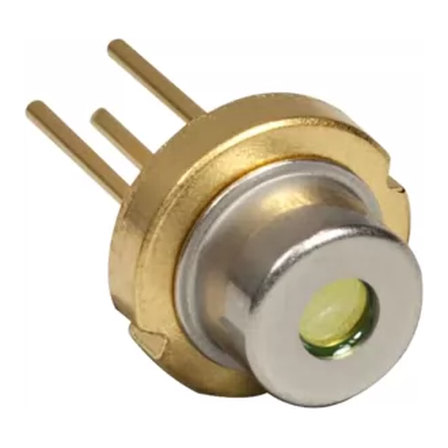
The PLD905BL-180W-M is a 180 W peak-power 905 nm pulsed laser diode built on stacked tunnel-junction technology with 6 emitters. It delivers 1 - 100 ns pulses and roughly 18 uJ of pulse energy at a 100 ns pulse width, and it ships in a TO56 package. A low thermal-drift variant keeps the wavelength stable across temperature.
180 WPeak power
18 uJPulse energy
905 nmWavelength
Estimated range
- Retro-reflective target1.6 km
- Diffuse terrain535 m
Range figures are engineering estimates for a matched-filter receiver, 36 mm receive aperture and 90 % optical efficiency. See the range equation article for the full derivation.
Every parameter on this page is transcribed from the manufacturer datasheet.
PLD905-* (V3.0) product specification
| Peak wavelength | 905 nm (895 - 915 nm) |
|---|---|
| Peak output power | 180 W |
| Pulse energy @ 100 ns | 18 uJ |
| Number of emitters | 6 |
| Aperture size (w x h) | 110 x 30 um |
| Beam divergence, parallel | 9 deg |
| Beam divergence, perpendicular | 25 deg |
| Spectral width (FWHM) | 7 nm |
| Wavelength temp. coefficient | 0.10 nm/K |
| Threshold current | 0.75 A typ |
| Operating current | 35 A |
| Operating voltage | 40 V |
| Forward current, max | 40 A |
| Pulse width | 1 - 100 ns (max 100 ns) |
| Duty cycle, max | 0.1 % |
| Repetition rate | up to 10 kHz |
| Operating temperature | -40 to +85 C |
| Storage temperature | -40 to +100 C |
| Package | TO56 |
| Est. range, retro-reflective | 1.6 km |
| Est. range, diffuse target | 535 m |
Key features
- 180 W peak optical power at 905 nm
- 6 stacked emitters, 110 x 30 um emitting area
- 1 - 100 ns pulse width, 0.1 % duty cycle
- Low threshold current, 0.75 A typical
- Low temperature drift, 0.10 nm/K
- TO56 package
Typical applications
- Laser rangefinders (LRF)
- LiDAR and time-of-flight sensors
- Drone ranging and obstacle avoidance
- Long-range laser designators
- Industrial and professional sensing
Need this part in a specific configuration?
Fibre pigtail, fast-axis collimation, a matched driver board or a filtered receiver - describe the build and we will quote against it.